

Future of Freedom
While evaluating societys future values, how could we not start with freedom?

Remember playing with the other children as a kid on the playground?
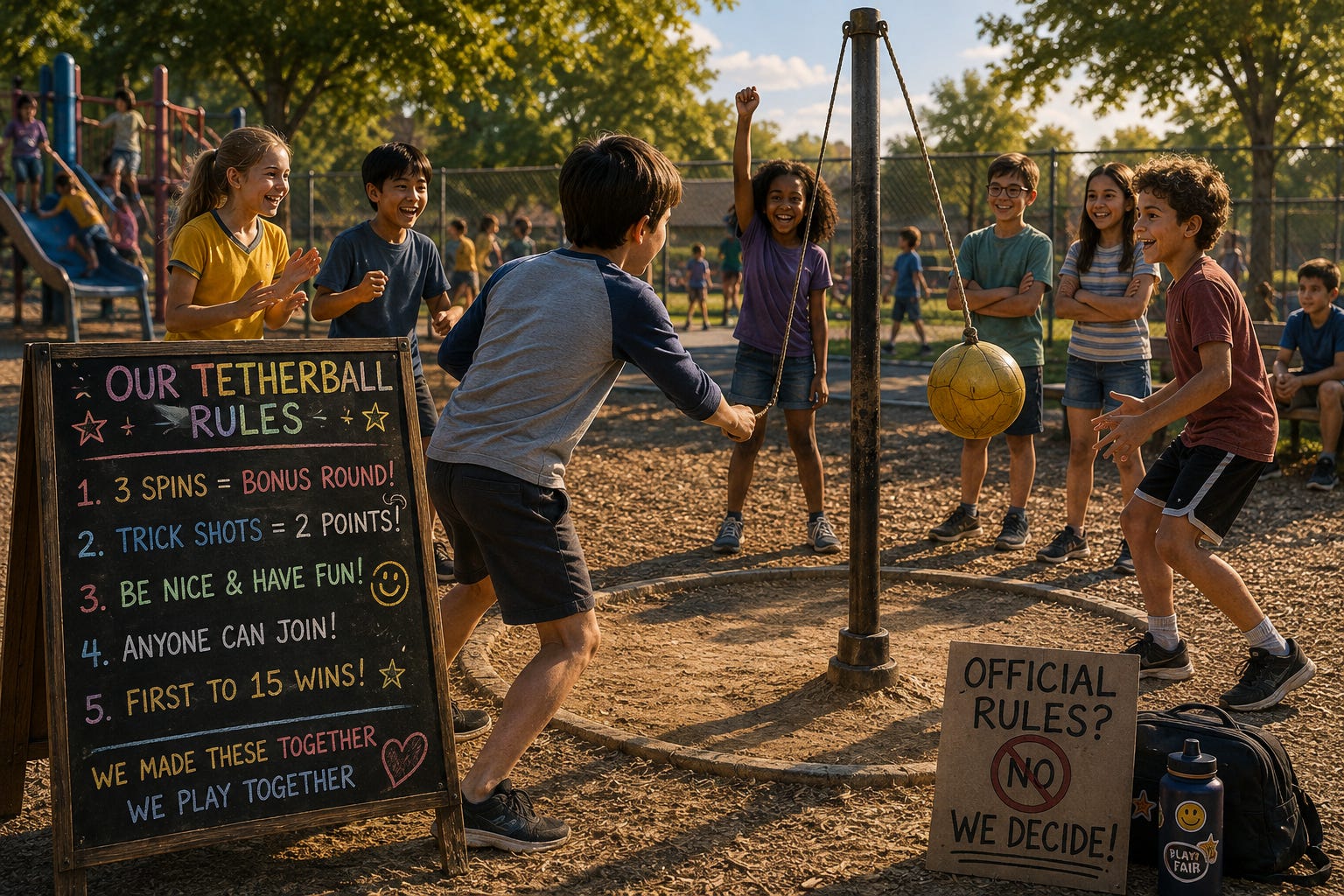
Everyone is running around — making up their own games, with their own rules. There was often a child or two who wouldn’t want you playing your way.
Your friends and you could make up your own rules to a game of tetherball; and eventually, after enjoying the new game for many days, another child would approach your group and tell you “you’re not allowed to play that way.”
The official tetherball rules state that you need to play a certain way, and that your group shouldn’t be allowed to play the way you want.
Some rules are good, some rules are bad.
A rule which says, “don’t push the other kids down and hurt them” probably feels pretty good. A rule which says “pay me $5 every time you want to use the tetherball court” probably feels pretty bad. And some rules are just preference.
“If it spins around 3 times without the other team touching it, we start a bonus scoring system.” Such a rule might not be regulation. Does that make it wrong? Who should decide?
The people playing of course. If everyone playing the game states they like this new system then why should another kid walk over and tell them they can’t play that way?
On the playground it is easy for the other kids to ignore the outside rule-maker. Once they become adults, it becomes much harder. The children which once policed the tetherball court grew up and started carrying guns. Placed fancy metal on their shirts, put robes over their outfits, and crafted gavels made from wood. Do these objects make such individuals moral, good, or just?
Good—Neutral—Bad
Aiding others (good)
Acting in self interest without significantly impacting people around, either negatively or positively (neutral)
Harming others (bad)
It makes little difference whether a person has a fancy piece of metal on their shirt, or a gun on their hip. Harm is harm. And nothing harms a person’s psychological health, physical health, or emotional health more than putting them into a cage.
History:
Such institutions previously made up rules such as:
“We can say that we own other people”
“Running away from someone who says they own you is a crime”
“Homosexual intercourse is a crime”
“Drinking alcohol is a crime”
“Smoking a plant is a crime”
These harmful, destructive, and abhorrent rules are almost universally acknowledged as wrong today. Yet for how long did such rules exist?
How many lives did they wrongfully destroy, believing the metal on their shirt made them right to do so? Can any other group in our society boast to have inflicted more harm? How many more wrongful rules still exist today?
Society routinely weaponizes the world’s economic system in order to inflict suffering. Deny a person opportunities — and they suffer, oft without food and shelter.
Yet it doesn’t stop there. Many of the rules invented make it illegal to exist without routinely paying money to the society. A system designed to inflict maximum pain and suffering on any people of their choosing; without warning and without means for rebuttal.
They made up a rule. You have no say in whether you have access to money or not. Just as you have no say in any of the numerous laws which make it a rule-violation to exist without adequate access to money.
A person might hear my words and think me anti-law or anti-police. On the contrary, I am pro-both. I advocated in defense of police spending amidst the defund the police movements. My wife and I hung a plaque on our wall commemorating our hometown police force in every city we ever lived in.
Some rules are good, some are bad.
Rules which state not to harm others are amazing. And the police officers who defend such rules are amazing. Truly, I am appreciative for any and all officers who defend a person’s freedom to exist; free from another person’s harm.
Yet for the metal on their chest to mean something, it must first become truthful. The only ones who can make it so are the police themselves.
“To protect and serve”.
That’s what the metal says. That’s what their actions would need to represent in order for it to remain truthful.
Every time a rule is made up and someone is harmed for it, such as marijuana-use being an obvious recent-example; the metal becomes a lie.
Who is protected?
Who is served?
The cage makes the affected party’s life worse, not better. Their families’ lives worse. Their ability to contribute to the society becomes lessened, making their communities worse.

“A joint” vs “a cage.”
One of those things shall provide a pleasant afternoon — the other shall ruin a person’s life. Neither the metal on their shirt nor the rule they made up justifies the harm they inflict; worsening their communities in the process.
Were the metal to hold value, police would prompt a pair of questions in their mind:
“Does this action make my community safer?” (protect)
“Will the parties affected via this case have improved lives as a result of my actions?” (serve)
Acting in accordance with such prompts would shape truthfulness into the metal; never again to see victimless-crimes enforced. Which are some of the most blatant culprits for worsening the society.
Let’s repeat that— victimless crime enforcement worsens communities.
Adherence to such prompts would see America return to become a free nation once again, just as the Founding Fathers intended… rather than the least free society on Earth.
More than 22% of the world’s incarcerated population is in America. More than 1 of every 5 people in a cage, is in America. That ranks as worst in the world — in a metric measuring the freedom of its people.
By drawing attention to its failing, we open up a doorway to improvement. Any nation claiming the mantle “leader of the free world” should have the least people in cages, not most.
Providing alternative pathways for at-risk groups is how we do that. Education for All provides people coming from troubled neighborhoods an alternative pathway in life. One neither of dead-end jobs, nor crimes and gangs. Self-directed development whilst living alongside their peers. The first and only period for equality-of-opportunity in our society.
Education for All: each person should have access to housing, food, and skill development— to live alongside their peers prior to adulthood (ages 15-20).
Some would go to college. Some would take classes online. Some would do apprenticeships. Some would teach themselves. Others would squander the time with their friends. All would live alongside one another for a 5 or 6 year period. I would take it a step further and place childcare and career counselors into the sub-communities. All potential outcomes are good. Providing opportunity. Increased sense of equality and fairness. Greater skill-levels felt throughout the society. And a period to shape some of the freest, most enjoyable memories in a person’s lifetime. What’s not to like?

With enough time, it is likely to propel the society from worst to first. Yet this alone isn’t enough. It will help, yet it will take time.
Removing victimless-crime laws will jumpstart the process.
First Principle of the Free World puts an end to victimless-crime laws by applying restrictions to government. Such a principle follows a blueprint left by the Constitution. Every government known to us forms rules which define what its people can’t do. What was supposed to make the Constitution unique was that it instead starts the process by defining what the government can’t do. First Principle does exactly this, yet it moves the line. Where the Constitution aimed for a society with more freedom, today the nation has less than its peers. First Principle corrects this, or will try to anyways. Specifically, it achieves this by targeting only the worst laws, victimless crime laws. It does not interject in laws pertaining to harm, such as: theft, rape, murder, etc.
First Principle: “no free-state shall interject itself between an autonomous individual and an act upon oneself, without consent”
Says the rules they make up must pertain to acts of harming the people around them. No more making up any rules they feel like.
How does the First Principle hold up versus the “good rule, bad rule” tests we mentioned earlier?
“No pushing kids down or hurting them”. This non-consensually harms the people around them. This is a good rule to have and the first principle would not stand in its way. This rule is valid.
“Pay me $5 to use the tetherball courts”. This one is difficult to evaluate. The rule obviously shouldn’t be allowed; yet how the First Principle would apply in this case feels ambiguous. Let’s call it a gray area for now. Let me know in the comments how you interpret it.
“No playing with the bonus system you and your friends made up”. This does not harm anyone around them non-consensually. This rule is invalid. First Principle would protect the players from the other child. He made up a rule trying to dictate how they play, in a way which harms no one.
“We can say that we own other people”. Firstly: this is an action upon others of non-consensual harm, the First Principle would apply to defend the individual from the rule-makers. Secondly: to leave their property is a choice which doesn’t harm anyone, another form of protection via the First Principle. Defending the individual not once, but twice, from corrupted rule making. Invalidated once. Invalidated twice. First Principle abides no such abhorrent practices.
“Drinking alcohol is a crime”.
This is textbook first principle protection. An act upon oneself… it is entirely the individual’s choice. This rule is invalid.
“Smoking a plant is a crime”.
Again, textbook first principle protection. An act upon oneself… it is entirely the individual’s choice. This rule is also invalid.
Does this system provide rampant increases of drug use? Do drugs flood into public spaces and influence kids?
No to both.
For the first part, Portugal has already tried it. After decriminalizing substance abuse in their country, their drug use rates are on par with all of Europe; whilst overdose and related disease spread has transformed to become the exemplar for the EU. Ranking amongst the lowest drug mortality rates in Europe.
What they found is that criminalization doesn’t reduce usage rates. Those who are deterred, are most often because of health impact and social stigma. Informational campaigns acting as the viable deterrents rather than punitive measures.
If you doubt Portugal’s model, pose yourself the question: “if meth-amphetamine was legalized tomorrow, would you do it?”
For most of us, the answer is no. We were taught the health risks, the addictive properties, and the stigma—which is why we wouldn’t. For those who do, the crimes form little deterrence. Instead police cage them, fine them, then remove these people from their workplaces — stripping them of housing, food, and dignity. Leading to significant declines in psychological, physical, and emotional health; alongside decreases in societal productivity. And to add insult to injury, it increases welfare usage and drives up the cost of healthcare. The individual, their family, and the society lose on all fronts. Instead of contributing, they often become increasingly dependent on welfare programs or turn to crime as their only felt means left to make money.
The other consideration is production and distribution. Consuming a drug is an act upon oneself—a choice a person makes which only directly affects themself—protected via the First Principle. Large scale production and distribution are most likely construed as actions upon others—which might not be covered in the First Principle; still vulnerable to regulation in a grayer area outside the principle. I.e you are free to use if you choose, but not necessarily free to produce & supply for others.
Likewise, drugs in public spaces — particularly where children are present — are gray area. Influence upon children may be construed as an action upon others, prompting regulations against use in public spaces. Yet such gray areas are inevitable in all policies, left to interpretation of the rule makers. This precedent in particular has high-potential to become abused by rule-makers if influence is allowed to act as justification too flexibly.
How does the First Principle reflect onto the good—neutral—bad scale? It lays very well. Good always being allowed. Neutral most-often allowed, though there a few gray areas. Bad things not allowed.
The principle draws a line. Each person is free to choose how they want to live — and so long as they aren’t harming others, everyone can co-exist.
Puts an end to victimless-crime laws and restricts the rule-makers to only shape rules pertaining to harming the people around them.
Not a basis for anarchy or the absence for the rule of law. On the contrary, it frees up more police time to focus on crimes involving actual harm. The serious ones (theft, rape, murder). Less focus on victimless-crimes, instead shifting more focus towards protecting and serving cases with actual victims. Which shall undoubtedly improve their reputations amongst their communities. We should expect less crime, less cagings, increased productivity, healthier societies, less welfare and healthcare spending, more freedom for you and the people around you. Again I shall ask, what’s not to like?
The First Principle does not form a perfect system but it helps us get there. Redirects the West towards its core value. It is likely to jumpstart any hopes the West has at going from worst-to-first when measuring freedom.