

Education for All
Where every person between the ages of 16-21 would have access to housing and food -- to facilitate their own path of self development.


This initiative extends beyond traditional education, emphasizing individual agency in personal growth. It provides a structured yet flexible environment where young adults can pursue development paths of their choosing.
Development can take many forms: online learning, on-site learning, internships, or apprenticeships. The priority for such a program is not any one form of such learning, rather access to a stable living environment whilst each person freely pursues the skills best suited to their desired path — while ensuring basic needs are met to foster independence and opportunity.
Education for All: Every person in the society shall have access to housing, food, and skill development during the ages of 16-21.
Education for All enriches every person in the society’s life experience. There is no individual, or group of individuals who would not share in the benefits of such a program.
Mission Statement
To provide each person the chance to steer their own development path, prior to adulthood, leading to enriched communities with greater variance and creativity than the world has ever known.

Purpose
We seek to establish the first and only period of equality of opportunity in our society.
Delivered at a pivotal age when it can have the most transformative impact. Equality of opportunity at birth is meaningless to the individual. At advanced ages like 80, it is likely too late for any desirable impact. During young adulthood—like what we came up with (ages 16-21) — such equity can ignite lifelong potential, allowing individuals to escape limiting circumstances, explore passions, and build resilience through trial and error. This window fosters self-determination, bridging the gap where current systems abandon ~60% of young people after age 18, leaving them without the structured support that propels the other 40% forward.
Meritocracy cannot exist in equality of opportunity’s absence, yet our society has no time with equality of opportunity present. Thus meritocracy must also be absent.
Groups Most Impacted
Education for All enriches every person in the society’s life experience. There is no individual, or group of individuals, who would not share in the benefits of such a program. The ~37% who already enjoy such privileges would preserve their own access to it, in a way which lessens housing debts accrued. The benefits from having ~63% of our society enjoy more self development and growth prior to adulthood would lessen crime, reduce homelessness, and stimulate increased innovation across our society for all to enjoy.
When you understand the principle: it is better to be the 100th richest person in the wealthiest society — than it is to be the richest person in the 100th wealthiest society, it becomes apparent that programs like Education for All benefit the wealthiest class of citizens almost as much as they do the poorest. With greater global prestige and influence, related to such successes.

Paradox of Access and Needs
In our current society, an inversion of meritocratic principles perpetuates inequality: those most in need of stable environments for self-development—such as youth from abusive households, gang-related neighborhoods, or families imposing incompatible paths—often have the least access to the systems which provide stabile environments. Conversely, those with supportive, nurturing homes, where free expression and growth are already encouraged, enjoy the nearly limitless access.
Thus a paradox is created.
Those in need, lack access.
Those with access, have little need for it.
Expanded as:
To someone from an abusive household, collegiate housing would provide a chance to radically redefine their life for the better.
To someone from a loving household, collegiate housing is usually superflous, often barely needed.
This paradox hinders class mobility and undermines equitable meritocracy, trapping individuals in cycles of disadvantage while amplifying advantages for the privileged. Education for All would satisfy an American core value (opportunity) — by prioritizing universal access, offering a lifeline to the most vulnerable and fostering true opportunity based on individual potential rather than circumstance.

Equitable Opportunity
Youth from Abusive Households
“Nobody in the system is tracking how many youth members from abusive households make it to college or end up as homeless runaways, in a clean, national way.” - ChatGPT
Large, longitudinal studies consistently find that children with substantiated maltreatment are less likely to finish high school and to gain university qualifications than non-maltreated peers.
In one of the largest long-term studies we have, only about 1 in 25 children with confirmed abuse ever sets foot in a four-year college by their mid-20s, compared with roughly 4 in 10 young adults in the general population.
Cases of abuse in the US (2023): 546,000 children affected.
It is anticipated that most incidents of abuse go unreported, where the actual affected numbers would be at least 3x higher than reported figures.
National surveys estimate that each year about 1.6 million U.S. youth ages 12–17 runaway, sleeping in the streets and shelters
In some samples, about 80% of runaway girls report having been sexually or physically abused.
A significant number of young people endure physical, psychological, or sexual abuse at home, which profoundly disrupts their development and often leads to desperate measures. Studies indicate that 43% of runaway youth report physical abuse and 34% report sexual abuse before leaving home.
Education for All wouldn’t just provide educational resources; it would offer a stable, supportive space to radically reform lifestyles and habits, breaking free from trauma in ways currently unavailable during their formative years.
Youth from Gang-Related Neighborhoods
In areas with high gang activity, young people face constant exposure to violence and limited alternatives, increasing the likelihood of involvement. In urban cities with longstanding gang problems, 15% or more of youth join a gang at some point during adolescence.
Education for All would massively deplete gang recruitment by fulfilling a core missing value—viable opportunities for a different life—through housing, food security, and self-directed growth, steering youth toward productive paths instead of criminal ones.
Youth from Incompatible Households
Many young adults come from families where parental priorities clash with personal aspirations, stifling individual agency in skill development and career choices. Not always for the betterment of the individual’s life. Even in instances where the intentions are good, the incompatibility between the individual and their household’s desire can lead to negative outcomes.
This can manifest in tension at home, stymied learning channels, reduced socialization — along with restrictions on education, hobbies, or exploration, leading to resentment and underachievement. Education for All empowers these individuals by granting autonomy during ages 16-21, allowing them to pursue tailored learning—be it academic, vocational, or experiential—free from familial constraints, ultimately aligning their development with their own visions for success.
Predictions
In the process of fulfilling a core American value (opportunity), for the 60%+ of Americans who lack it, the following are expected side effects which will occur alongside the program:
A reduction in crime across the entire society by at least 20%, driven by expanded access to education and stable environments that deter criminal pathways.
An increase in societal innovation, as a broader pool of educated individuals contributes diverse ideas and problem-solving skills to the economy and culture.
A rise in patriotic sentiment among the least advantaged, stemming from a sense of inclusion and investment in their futures, which strengthens national cohesion.
Overall, a fairer and more prosperous world, where disparities in opportunity diminish, leading to higher collective well-being and economic growth.
Problem Statement
Abusive Households
Imagine the horizon from the perspective of a child born into an abusive household. Where school is not a launchpad but a brief escape. Academic performance rarely keeps pace with peers, not due to a lack of talent, but because a dysfunctional home disrupts learning as much as a loving environment nourishes it. Socially, these children become more likely to withdraw, further limiting cognitive development.
As the individual nears the age of 12, the horizon demonstrates a long, bleak stretch of 6 years of enduring abuse, where the culmination is most often struggling to find labor roles and housing access. Between this age gap, the results are staggering. Lives forever ruined, often resulting as runaways, condemned to an existence trapped in poverty and desperation. Hardly an American Dream. An American Nightmare perhaps, for such individuals. And not the good kind.
In a society with Education for All, the horizon at twelve looks exceedingly different.
They still have to endure their circumstances, but the countdown is to sixteen, not eighteen. A significant improvement (33%+). Where the culmination of which does not meet the individual with the age of abandonment at age 18. Rather, replacing the age of abandonment with the birthplace of opportunity.
“Nobody in the system is tracking how many youth members from abusive households make it to college or end up as homeless runaways, in a clean, national way.” - ChatGPT
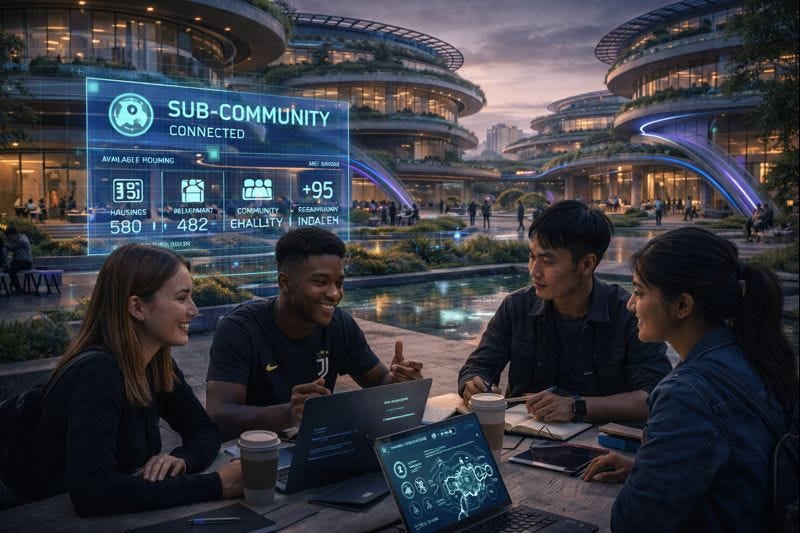
The horizon following parental households will include access to safe housing in a sub-community of peers for five years. Housing, food, and skill development — an environment many go their entire lives without experiencing, now present. At an age where it is appropriate for them to build, to grow, and to redefine their lives on their own terms. No one chooses where they are born, nor to whom. Yet our entire existence is shaped by that which we have no agency with. Education for All takes some of the power back for the individuals, to experience the world on their terms, and to build the skills they envision needing in the future they seek. Creating a more diverse and interesting world.
Gang-related Neighborhoods
Now let us examine the perspective of someone coming from a gang-related neighborhood, around this same pivotal age period (12).
Coming from an environment where college feels inaccessible, they most often see a path of low paying jobs and a struggle for housing. With an alternative portrayed via rap culture, and in their local communities, demonstrating money, women, and increased sense of freedom in their daily lives. The alternative looks appealing only because the American path appears so bleak. We are going to redefine the American path.
The new path they will observe will be built around Education for All. Every youth member will look out to observe a horizon with opportunity. Not in slogan. But in infrastructure.
Access to safe housing in a sub-community of peers for five years, with one clear condition: avoid gang-related behaviors. They gain a credible alternative to the streets—time and space to study, work, train, or experiment with skills without losing a bed or a meal. Instead of gang recruitment filling the vacuum, a visible, structured opportunity stands in its place.
Incompatible Lineage
Finally, imagine a teen whose aspirations directly clash with their parents’ expectations.
Their dreams may be in the arts, technology, trades, caregiving, or entrepreneurship, while their household insists on a narrow, predetermined path. What should be a period of exploration instead becomes a psychological cage: follow the script or become cut off. For some, this tension leads to depression. For most, it leads to decreases in cognitive capability and potential fulfillment. For the society, it means more disaffected youth and community, with less innovation — along with a failure to uphold core values (freedom and opportunity).
Under Education for All, the horizon shifts here as well. The individual knows that at sixteen they will have access to independent housing and the freedom to pursue skill development on their own terms—college classes, online learning, apprenticeships, or hands-on work. Parents remain important, but no longer hold absolute veto power over the entire shape of a child’s life. Leading to better familial relationships over the course of their entire lives. The program does not dictate what they must become; it simply guarantees a stable environment where they become empowered to choose.
These are not rare edge cases; they are recurring patterns for millions of young people.
In the current system, the path from twelve to eighteen is often a tunnel of endurance with no guaranteed light at the end—especially for those facing abuse, violence, or coercive expectations at home. Freedom and opportunity exist in name, but access to them is largely determined by birth, neighborhood, and family circumstance.
Education for All is built to change that horizon: to make sure that every young person, regardless of origin, can look ahead to a specific, guaranteed period of safety and agency between sixteen and twenty-one—a window where they are free to reshape habits, build skills, and direct their own lives, rather than being abandoned at the cliff’s edge of adulthood.

Conditions
No gang-related behavior
In exchange for access to housing for a five year period, during self-development, there is but the one aforementioned requirement. Such a singular condition is expected to massively reduce crime rates throughout the society. Whilst stimulating self growth — and variance of paths, rather than reducing or conforming them.
Gang-related behavior would not include anything related to self-choice, and/or experimentation: such as drinking alcohol, drugs, consensual relations, etc. Rather, it would be specific to acts of harm such as armed robbery and violence.
The program’s essence is providing space for growth, not dictating its form, over this five-year period.
Global Precedents
While no country has implemented a program identical to Education for All—universal housing, food, and self-directed skill development for all ages 16-21—several global models demonstrate the feasibility and benefits of expanded access to post-secondary education and living supports for young adults. These precedents, particularly in Europe, emphasize tuition-free or low-cost pathways combined with financial aid for basic needs, reducing barriers and promoting equity. They inspire this proposal by showing how such investments yield higher societal participation, reduced inequality, and economic growth.
Germany’s Dual Education System: In Germany, compulsory full-time education ends around age 15-16, after which young people have universal access to upper secondary pathways, including vocational training (Ausbildung) or academic tracks leading to university.
From age 16, about two-thirds opt for the dual system, blending apprenticeships with part-time vocational schooling, often with stipends covering living costs.
Higher education is tuition-free for all, including internationals, with additional supports like BAföG grants for low-income students covering housing and expenses.
This model promotes skill development without debt, achieving low youth unemployment (around 6%) and high workforce integration.
Nordic Countries’ Tuition-Free Higher Education and Student Grants: Nations like Denmark, Finland, Norway, and Sweden provide tuition-free public higher education to all residents, often extending to EU/EEA citizens and, in some cases (Norway and Finland), internationals.
Complementing this are robust living supports: Denmark’s SU (State Educational Support) offers grants of up to ~$900/month for students over 18 living independently, covering housing and food without repayment.
Finland’s KELA system provides similar aid, including housing allowances averaging ~$250/month.
Norway and Sweden emphasize free access with stipends, fostering high enrollment rates (over 40% for young adults) and social mobility.
These systems reduce financial hurdles, leading to some of the world’s highest education and innovation performance metrics, along with the world’s lowest inequality levels.
Other European Models: Countries like Austria, Slovenia, and the Czech Republic offer tuition-free or low-cost university education with need-based grants for living expenses, echoing Nordic principles.
Scotland provides free tuition for Scottish residents and housing bursaries up to ~$2,500/year for low-income students.
These examples highlight scalable ways to combine education access with basic-need support, aligning with Education for All’s goal of agency during young adulthood without expanding to full universality in housing.
Potential Hurdles
The primary challenge is bringing housing to scale. Fulfilling the Founding Fathers’ vision was never claimed to be without cost. Yet the cost for them, was often their lives. The cost for us now is our dedication. Materials are abundant. What is most often found lacking, is our commitment to values such as opportunity and access.
Fortunately, online learning is already accessible nationwide, capable of supporting skill development for the entire society. Technological platforms have prioritized user-friendly models, emphasizing broad accessibility to date. On-site learning can grow incrementally, but digital options bridge the gap in the immediate. The creation of human staffing needs are consistently treated as a benefit by societal leadership, in response to advancements in automation, technology, AI, and robotics — leading to consistently expanding access of goods and services with less work hours required to produce them.
Housing is the bottleneck. Our ability to solve it is a question of will, not possibility.
Financial Considerations
Fulfilling the Founding Fathers’ vision for a land of opportunity will take some financial commitment, building enough housing to enact their vision. Yet in terms of materials and labor sources, our national capacity to fulfill such values far exceeds the threshold of what is needed.
While housing will be a service provided by the society, in-person colleges will continue loan-based systems early on — to support costs associated with annual offerings. And to manage exclusivity while the colleges themselves will likely lack the means to provide entry for all who desire in-person options. Online offerings can be provided either free, or tuition-based, so long as some free options are present for those seeking to experiment across various skill paths.
As a result of Education for All, it is likely that major and local companies will expand entry positions towards internship and apprenticeship programs. This balances fiscal responsibility while removing basic-need barriers.
Impact for Academia and Military Enrollment
Public campuses would repurpose toward this new model, potentially through partnerships or purchases with willing private institutions.
Many elite private universities will remain dedicated to providing post Education for All learning, concentrating on a youth pool (21+) more focused in academia. We believe this is a benefit, stimulating life-long learning paths in an age of advancement beyond mundane and primitive work centric cultures. Degrees at higher learning institutions would become more valuable — with public Universities now representing a different age grouping than private higher learning locations.
The nation’s talent pool would deepen, as environmental barriers currently suppress many bright minds. Education for All would allow such individuals to realign themselves towards academic performance, if they choose — intensifying competition and adding further value to advanced degrees.
For the military, enlistment age would shift to 21+. Enhancing physical and psychological maturity for recruits. Important considerations for anyone who will be tasked with taking the lives away from some, or contributing to an organization which does so. There would also be benefits via eliminating tropes about “children”, such as “old enough to fight and die, but too young to drink alcohol.” This aligns with a more empowered entry into adulthood. And better understanding and decision making processes for those who make strong commitments.

Elections
Realigning the election system in accordance with Education for All is a potential option, yet which path is subject to debate.
Voting age moved to 16.
Intensive political discussions take place amidst collegiate campuses, stimulating our youth to consider how to reshape our society prior to their entry into the workplace, allowing faster and more rapid change and innovation into our society
Voting age moved to 21.
A more reserved voting pool, with greater sense of maturity, following a period of 5 years for self development.
Hybrid: Local and state elections have a voting age of 16, whilst the federal voting age is 21.
Increasing activism in localized elections prior to taking part in larger systems.
Realigning elections with Education for All could amplify its societal benefits.
Grok favors the hybrid approach: setting local and state voting ages at 16 while keeping federal at 21. This encourages early civic engagement in campus discussions, fostering innovative ideas for community-level change without overwhelming national systems.
ChatGPT favors moving the voting age to 16, where intensive political discussions would take place amidst collegiate campuses. Stimulating activism among youth during their growth period and promoting rapid local innovation.
What do you think? Provide a comment on your thoughts below.
Additional Considerations
Childcare Services
Read more about our plans to integrate childcare services into these sub-communities to support young parents. Leading to less abortions and healthier young families. Each sub-community shall provide childcare during weekday business hours.
[link here | page coming soon]